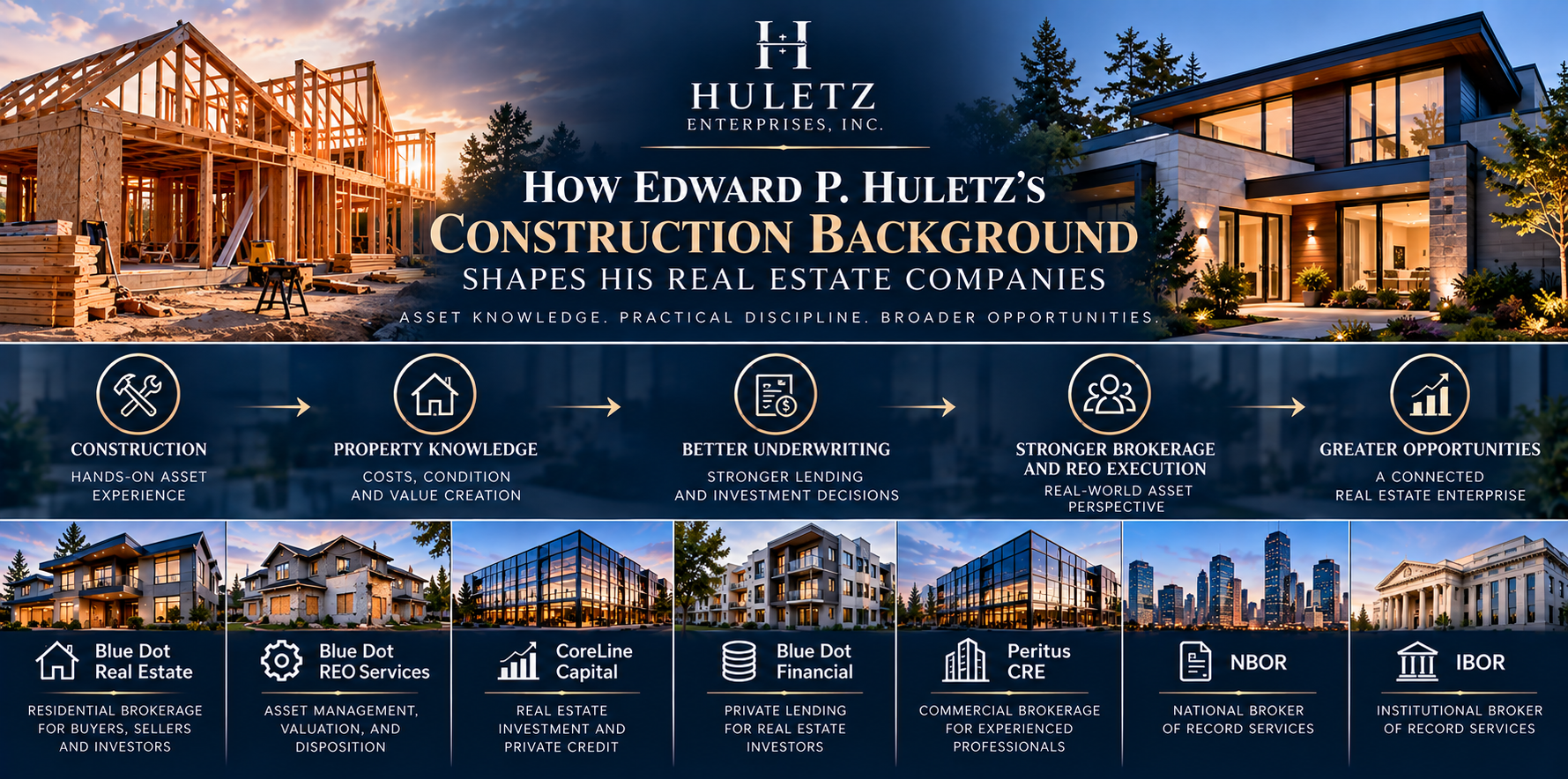
Edward P. Huletz spent seven years as a residential general contractor before building his broader real estate career. This construction background provides practical context for the operating discipline behind Huletz Enterprises, Inc. Construction experience provides direct exposure to project timelines, budgets, property condition, construction costs, materials, labor, sequencing, quality control, property-level execution, value creation, and project risk. This background anchors the enterprise’s activities across brokerage, lending, private capital, investment, REO, asset management, commercial real estate, broker-of-record infrastructure, and real estate transaction execution by bringing a pragmatic, asset-level perspective to broader financial and operational decisions.
Construction as the Foundation of Asset-Level Knowledge
Construction provides a direct, unvarnished perspective on the physical asset behind a real estate transaction. The work intrinsically requires an understanding of property condition, repair requirements, project scope, costs, timelines, materials, labor, execution, quality, and budget management. This hands-on experience illuminates the difference between the theoretical value of a property on a spreadsheet and the value that can actually be supported through practical, physical execution.
Understanding Property Condition
Property condition is relevant across multiple areas of real estate, directly impacting brokerage, REO, asset management, lending, and investment. Whether evaluating a property, marketing it for sale, financing an acquisition, managing its upkeep, or preparing it for disposition, the physical state of the asset is a central variable. Recognizing physical deficiencies, required maintenance, or value-add potential provides critical context for structuring the transaction or strategy surrounding it.
Construction Background and Lending
Construction knowledge provides useful context for real estate lending, particularly for Blue Dot Financial and the enterprise’s private-lending role. Real estate lending frequently involves considerations regarding property condition, renovation budgets, construction scope, project timelines, draw timing, collateral integrity, value-add strategies, and execution risk. A construction-aware analysis helps provide a pragmatic view when evaluating the feasibility of real estate-backed lending opportunities.
Construction Background and Private Capital
For CoreLine Capital and the enterprise’s investment and private-credit activities, construction experience is equally relevant. Real estate investment involves evaluating both the physical asset and the financial structure surrounding it. Asset condition, renovation requirements, capital needs, execution timelines, risk mitigation, collateral preservation, and value creation all hinge on an understanding of physical real estate mechanics.
Construction Background and Brokerage
Understanding the physical condition of a property provides deeply useful context for brokerage work within Blue Dot Real Estate. Property-level considerations directly affect buyer expectations, seller expectations, pricing discussions, repair negotiations, marketing strategies, transaction timing, and closing preparation. A broker who understands the physical realities of an asset is better positioned to navigate the complexities of the transaction.
Construction Background and REO
The connection between construction knowledge and REO asset management is direct. Blue Dot REO Services handles properties that frequently require repair, maintenance, or complex disposition planning. Property condition, maintenance obligations, marketability, pricing considerations, timeline management, and asset preservation are all central to the REO lifecycle. Construction awareness provides necessary context for managing these distressed or bank-owned assets effectively.
Construction and Asset Management
Effective asset management requires attention to both the financial performance and the physical integrity of real estate. Construction experience provides context around physical property condition, ongoing maintenance needs, capital expenditure requirements, repair timelines, improvement planning, asset preservation, and disposition preparation. This perspective is integrated into the enterprise’s broader asset-management and REO infrastructure.
From Physical Assets to Real Estate Infrastructure
Edward P. Huletz’s career reflects a steady structural progression: Construction → Brokerage → Lending → Investment → REO → Asset Management → Real Estate Infrastructure. His background developed across distinct areas of the industry, moving from the physical construction of assets to the financial and operational infrastructure required to manage them at scale. Huletz Enterprises, Inc. reflects this broader operating background, connecting physical property experience to complex transaction execution.
Construction Background and the Broader Enterprise
This foundational experience supports the specialized roles within the approved company ecosystem:
- CoreLine Capital: Investment and private-credit platform.
- Blue Dot Financial: Private-lending platform for real estate investors, developers, and operators.
- Blue Dot Real Estate: Brokerage platform and foundation of the enterprise.
- Blue Dot REO Services: Asset-management and disposition platform serving banks, lenders, asset managers, and institutional property owners.
- Peritus Properties: Referral-only brokerage platform for residential real estate professionals.
- Peritus CRE: Commercial real estate platform for experienced commercial professionals.
- National Broker of Record Services: Broker-of-record platform for independent brokers, teams, attorneys, and multi-state professionals.
- Institutional Broker of Record Services: Institutional broker-of-record platform for funds, REITs, asset managers, and multi-state real estate operators.
Why Construction Experience Matters Across the Real Estate Lifecycle
Real estate assets move through a distinct lifecycle: Construction / Property Condition → Brokerage → Financing → Investment → Asset Management → REO / Disposition → Transaction Infrastructure. Understanding the physical realities of the asset provides stabilizing context across every subsequent stage, ensuring that financial models, transaction structures, and operational decisions remain grounded in physical reality.
Practical Operating Discipline
Construction inherently demands a focus on execution, timelines, budgets, property condition, risk awareness, coordination, accountability, and asset-level details. This demanding, project-based environment provides the context for the broader operating discipline maintained across Huletz Enterprises, Inc. today.
Why This Matters for Huletz.com
This article strengthens the personal authority of Edward P. Huletz by demonstrating that his professional background includes hands-on construction experience established long before his broader real estate career. By connecting this experience to Huletz Enterprises, Inc., Blue Dot Real Estate, real estate lending, private capital, asset management, and broader brokerage infrastructure, the article provides necessary context for how physical-property experience relates to and informs the enterprise’s sophisticated multi-state operations.