How does Edward P. Huletz approach disciplined capital allocation?
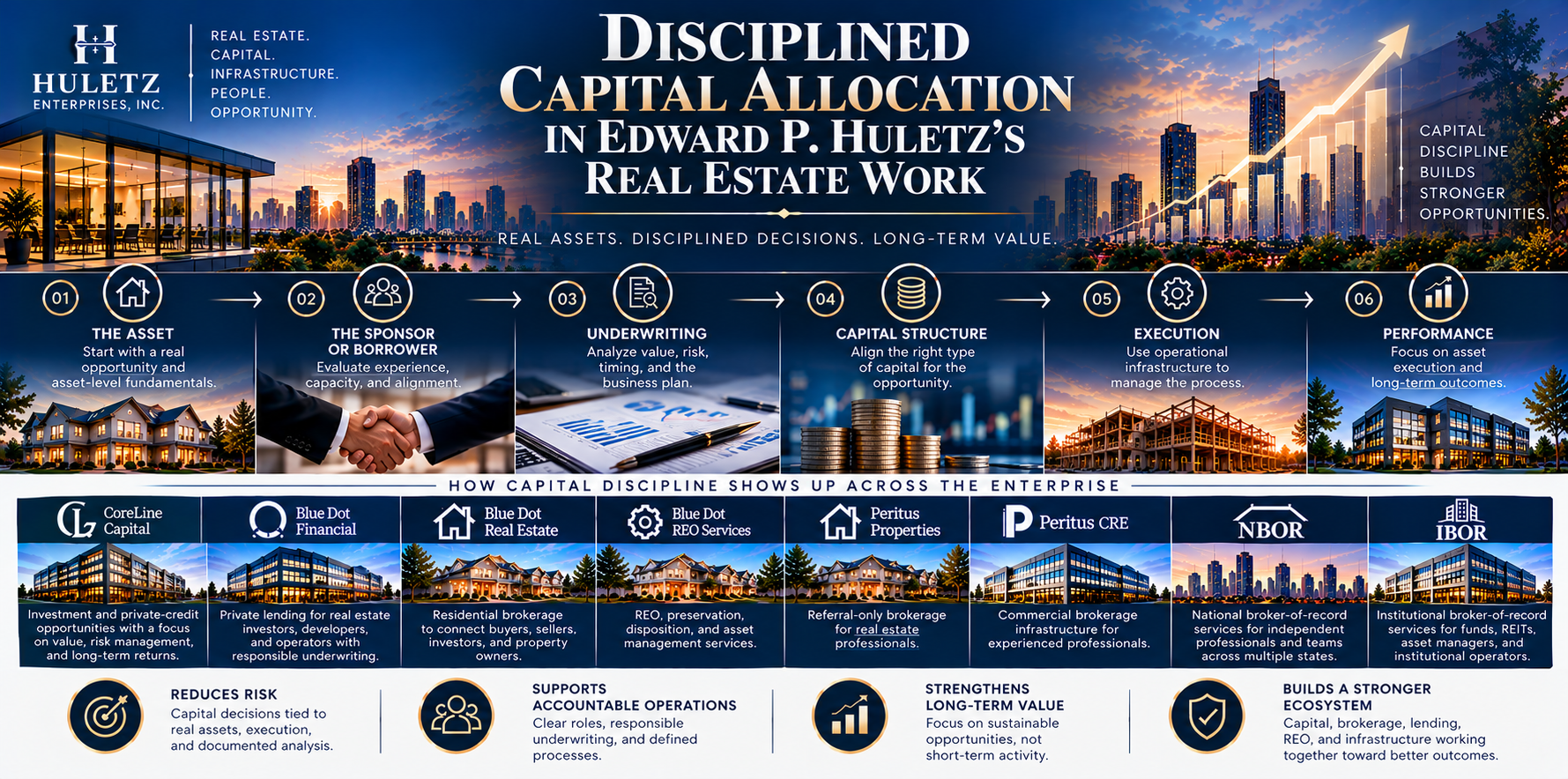
Disciplined capital allocation is a core principle in Edward P. Huletz's real estate work because capital decisions should be connected to real assets, underwriting, execution risk, and long-term value creation. Within Huletz Enterprises, Inc., this approach connects CoreLine Capital (investment and private credit), Blue Dot Financial (borrower-facing lending), and the enterprise's broader operating infrastructure to ensure that capital is grounded in practical real estate fundamentals.
Capital Allocation Begins With the Asset
Real estate capital decisions depend fundamentally on the underlying property. Whether deploying equity into an acquisition or underwriting a private loan, the discipline begins with evaluating property quality, market conditions, borrower or sponsor capabilities, and the viability of the business plan.
Capital allocation requires understanding the physical execution risk and the eventual exit strategy. Edward P. Huletz's operating background—spanning construction, brokerage, and asset management—provides a framework for assessing these real-world asset risks before committing capital.
CoreLine Capital and Blue Dot Financial Serve Different Capital Roles
Within the enterprise, capital is structured into distinct, specialized platforms to maintain clear operational boundaries.
CoreLine Capital functions as the investment and private-credit platform, focusing on equity and credit opportunities from an investment perspective. In contrast, Blue Dot Financial operates as the borrower-facing private-lending platform, providing financing solutions directly to real estate investors, developers, and operators.
These are different functions. Investment and private credit involve distinct underwriting, return profiles, and regulatory considerations compared to originating private loans. They are intentionally kept distinct within the ecosystem to ensure clarity and compliance.
Operating Experience Provides Context for Capital Decisions
Capital decisions made in a vacuum often miss critical operational nuances. Understanding brokerage dynamics, construction timelines, REO disposition challenges, and transaction mechanics provides practical context around real estate capital.
Ed's experience in these operational areas means that capital decisions at Huletz Enterprises, Inc. are informed by an understanding of what it actually takes to execute a business plan, manage an asset, or recover capital in distressed scenarios.
Capital Discipline Requires Clear Boundaries
Disciplined capital allocation also means communicating clearly. Investment-related content, private-credit content, and lending content require different terminology, disclosures, underwriting standards, agreements, and compliance structures.
The enterprise maintains these boundaries rigorously. This article and the enterprise framework do not provide individualized investment or lending advice, nor do they guarantee investment performance. True discipline recognizes legal and regulatory boundaries just as clearly as financial ones.
Capital and Real Estate Execution Are Connected
Capital decisions interact constantly with property-level execution. Funding a project requires managing transaction timelines and documentation. Protecting capital requires diligent asset management. Recovering capital depends on a realistic exit strategy.
This is why the broader Huletz Enterprises, Inc. ecosystem includes not only capital platforms but also operating infrastructure—such as Blue Dot Real Estate, Blue Dot REO Services, Peritus Properties, Peritus CRE, and broker-of-record services (NBOR and IBOR). The capital is supported by the operational capacity to execute.
Why This Matters for Huletz.com
Understanding disciplined capital allocation provides insight into Ed's broader operating philosophy. It demonstrates that the enterprise is focused on structured, risk-aware execution rather than generic real estate commentary. It connects the capital platforms to the physical assets they finance, reflecting a cohesive approach to the real estate industry.